Big-Box Retail Roofing in Vacaville, CA
Plan Vacaville big-box roof repairs around wide roof zones, rooftop equipment, loading access, drainage, tenant operations, and safe close-in timing.
A broad retail roof can hide a small leak across a long path from the opening to the ceiling stain. A Central Solano County heat advisory has included Vacaville during periods of very high daytime temperatures and warm nights. That weather pattern makes sheet movement worth checking at laps, curbs, and edge metal, but it does not establish damage at any building. We inspect the actual assembly, map the reported symptom, and compare it with seams, drains, and equipment bases before choosing a repair limit. A written scope then ties the roof zone to loading, customer access, and the period available for close-in.
Map loading and customer paths
Before material arrives, the property team identifies delivery hours, receiving doors, customer routes, fire lanes, and any lift locations that must stay open. A large store can have a main entrance, pickup area, loading dock, and service yard operating on different schedules. We mark those routes on the work sequence, then divide the roof into bounded areas with an identified close-in point. The schedule names who confirms a delivery, who clears the lift zone, and which section can be opened without crossing active access. An occupied-property sequence can record notices, interior protection, and daily shutdown checks.
North Village is a planned mixed-use area with housing, business activity, schools, public uses, and open space. That district context does not identify a particular store layout. A property near North Village still needs its own truck path and staging rules confirmed with management. A store near Downtown Vacaville may have different pedestrian and delivery constraints. The operating plan, not the district name, sets the approved route.
Divide the field by assembly and drainage
Wide roof fields may connect several structural bays, but additions and equipment changes can create different layers or attachment patterns. We compare drawings with visible membrane, seams, metal edges, curbs, fasteners, prior patches, and any change in slope. A stain near the sales floor may sit downhill from a penetration or along a deck joint. We trace a plausible water path and identify what remains untested. If a test opening is justified, the report marks its location and the layer exposed rather than extending one finding across an entire roof.
For a Vacaville delivery, I-80 links the Bay Area to Sacramento and I-505 provides another regional approach; road access offers no map of a building’s rooftop drainage. We check the actual outlets and low points, including drains and scuppers, and note standing water, blocked strainers, or an overflow that does not receive flow. Owners can compare shopping-center roof planning when the same property includes smaller tenant bays. The assembly and outlet map determine whether one repair zone can stay separate from another.
Where a roof has several elevations, we note how each section drains rather than treating the entire footprint as one plane. Water held behind a curb or on a low-slope transition can remain after the main field appears dry. The survey records the outlet serving that area, photographs any obstructed path, and checks whether an overflow is positioned to protect the edge. If a repair changes the surface height, the scope also confirms that water can still reach the intended drain. These checks help prevent a sound patch from redirecting runoff into another zone.
Inspect curbs and large rooftop units
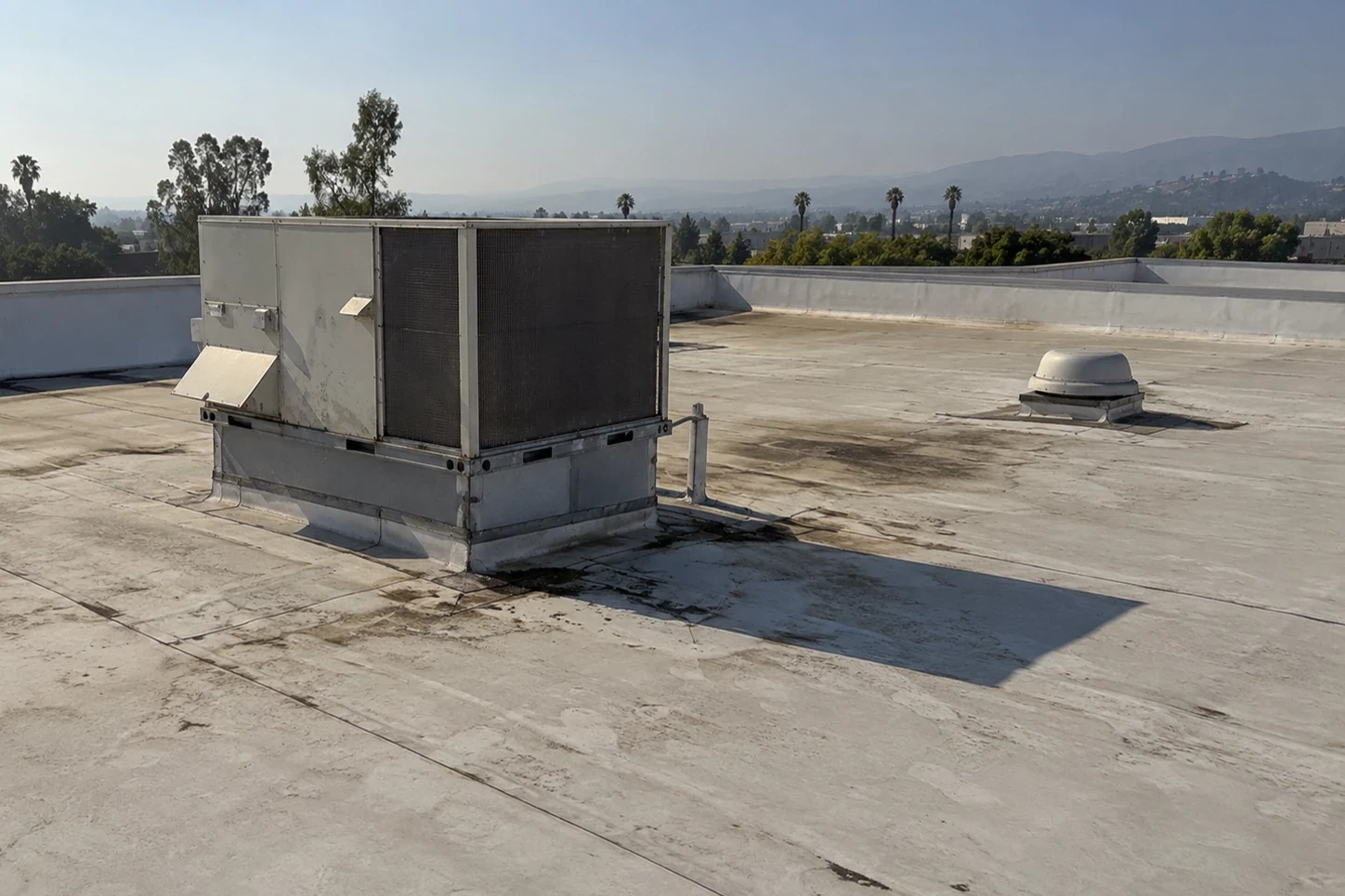
Retail buildings may support several large HVAC units, exhaust equipment, electrical runs, and service walks. We inventory what is present, inspect curb corners and flashing, and note clearance needed for maintenance. A unit that blocks a seam can change the path for water or a crew. We do not assume that equipment can be moved during roofing; the owner identifies the mechanical trade and any shutdown requirement before a curb is opened. The scope distinguishes membrane work from equipment disconnection, lifting, and recommissioning so each task has a responsible party.
Vacaville identifies advanced manufacturing, industrial production, biotechnology, and logistics among local economic sectors. Those uses contribute to commercial activity but do not predict a retail roof assembly. At the building, we check the fastening pattern, substrate, and receiving surface. A curb and support inspection can document each transition, while a perimeter metal review checks the terminations exposed to daily heat movement. The record connects each photographed detail to a roof zone and the proposed work.
Separate a visible symptom from its opening
A ceiling symptom can be displaced from its entry point. We compare its timing with the roof geometry, interior conditions, drains, seams, and penetrations above sales, stock, office, and receiving spaces. A ceiling tile replacement may hide a symptom without resolving the entry point, so the inspection identifies what has been observed and what is still a possibility. Moisture testing can help define a boundary, but a reading must be interpreted with the assembly and test method. Where concealed layers remain uncertain, we list the additional opening that could change the recommendation.
Temperature changes can stress laps and metal joints, while rain can reveal how runoff moves across the roof. Neither condition diagnoses a leak by itself. We note the visit conditions and inspect for open seams, loose fasteners, failed sealant at a detail, and water retained at low points. A commercial roof inspection can create a photo log and map for follow-up. The owner receives a clear distinction between confirmed defects, symptoms, and questions that still require testing.
Choose a repair boundary that can hold
A focused repair may fit an isolated opening when surrounding membrane is bonded, insulation is sound, and the patch can terminate on compatible material. Multiple leak zones, widespread wet insulation, loose attachment, or deck deterioration can justify selective removal or broader replacement. We compare those options against access, removal depth, equipment coordination, disposal, tenant disruption, and the amount of roof that can close before operations resume. If a recover is considered, the existing layers and moisture findings must support it; another layer cannot resolve an uncorrected opening or concealed wet material.
The proposal identifies each test result, assumed boundary, and condition that would change the scope. It also records who moves equipment, how customer and delivery paths remain clear, and what inspection occurs before close-in. Work photos are tied to roof zones rather than a general property label. For stores with a mix of smaller retail bays, a grocery roof review may add questions about refrigeration equipment and service routes. The closeout includes repaired details, materials, remaining watch items, and the next inspection point.
Questions Owners Ask
Can roof work proceed while the store remains open?
The manager sets customer, receiving, and fire-lane limits. We phase the roof by zones, protect interior areas below openings, and confirm lift and delivery timing before work starts.
Why can a leak show up far from the roof opening?
A ceiling mark may become visible after water crosses hidden roof layers. We match its location with field seams, equipment details, drains, and prior work, then test if the route remains unclear.
What should a large retail roof inspection document?
The report can map roof zones, membrane and metal details, equipment curbs, outlets, moisture tests, interior symptoms, and access limits. Photos should identify each location and any remaining uncertainty.
When is a localized patch a reasonable choice?
A patch may suit a defined defect with bonded, dry material around it and a compatible surface for the new detail. Broader moisture or attachment problems call for a larger scope comparison.
How do rooftop units affect roofing work?
Each curb needs a flashing review and service-clearance check. The owner and mechanical trade confirm any movement, shutdown, or reconnection before the roofing crew opens that transition.
Related Roofing Work
- Occupied Commercial Building Reroofing in Vacaville, CA
- Commercial Roofing in North Village, Vacaville, CA
- Commercial Roofing in Downtown Vacaville, CA
- Commercial Roof Drain and Scupper Repair in Vacaville, CA
- Shopping Center Roofing in Vacaville, CA
- Commercial Rooftop Equipment Curbs and Supports in Vacaville, CA
- Commercial Roof Edge Metal, Coping, and Gutter Service in Vacaville, CA
- Commercial Roof Inspection in Vacaville, CA
Share the leak location, roof records, equipment schedule, and delivery rules. We can map the affected area and identify the repair boundary and close-in sequence.