PVC Roofing in Vacaville, CA
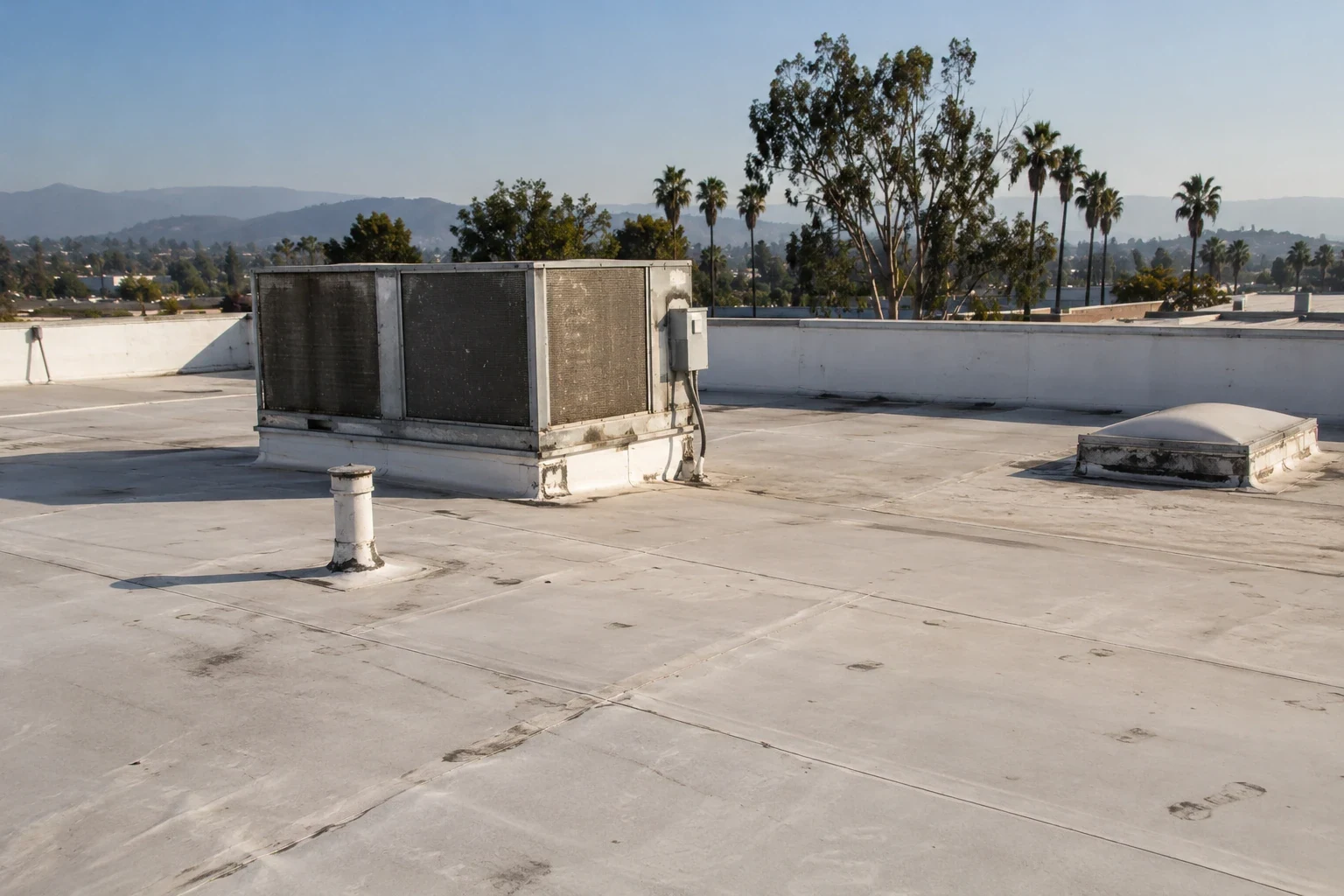
Compare PVC membrane installation and repair in Vacaville, CA. We check chemical exposure, welds, insulation, drainage, and transitions before setting scope.
Warm nights and very high daytime temperatures were forecast in Central Solano County, including Vacaville, CA. That regional forecast does not tell us what a roof has endured, so we examine the membrane and its connections directly. Polyvinyl chloride, or PVC, is a thermoplastic sheet with hot-air-welded seams. The weld can make a durable water barrier, but the assembly still depends on sound insulation, secure edges, and correctly flashed curbs. We look for chemical exposure, seam contamination, movement at equipment, and places where water takes too long to drain. A commercial roof inspection gives the owner a clear record before choosing repair, recover, or replacement.
Start with what reaches the membrane
PVC is often selected where rooftop exhaust, grease, or other chemical contact matters. The specific exposure needs to be identified before choosing the sheet and its details; a generic description of the tenant operation is not enough. We ask where exhaust travels, whether service equipment drips onto the field, and which maintenance routes cross the roof. Then we examine changes in color, surface texture, and seams near those paths. Chemical resistance varies by product and exposure, so the specification must match the actual substance and expected concentration. In Vacaville, biotechnology, advanced manufacturing, industrial production, and logistics are established economic sectors. Those uses make rooftop equipment and service access worth mapping during design, without assuming every building shares the same exhaust or roof condition.
A welded seam needs clean contact
Hot-air welding softens the PVC surfaces until they fuse. Dust, moisture, old adhesive, and incompatible patch material can interrupt that bond, while poor temperature or travel speed may leave a weak edge. We probe suspect seams, cut a small test only when needed, and confirm that the prepared surface is suitable before a repair is welded. At a replacement, the installer controls overlap, weld width, and consistent pressure as each sheet is joined. A lap that looks closed from above still needs a probe check after cooling. At roof edges, the weld also has to join cleanly into the flashing and metal termination. We test that connection before removing the temporary protection, since a strong field seam does not repair a weak perimeter. That step helps separate a true bond from a flap pressed flat by foot traffic. When the seam failure is part of a wider wet area, a seam failure repair has to include the affected insulation and the sound boundary around it.
Keep the layers in agreement
A PVC membrane sits over a roof assembly that may include a deck, vapor retarder, insulation, cover board, and attachment or adhesive. Each layer affects movement, puncture resistance, and how water travels after a leak. We inspect the exposed board at transitions and use moisture testing where the field suggests concealed wet material. Soft insulation can let fasteners loosen and can leave the new sheet without a stable receiving surface. If a recover is under consideration, the roof height at drains, doors, curbs, and parapets must be checked along with retained layers. A compatible recover review documents those limits before another membrane is added.
Treat every interruption as a detail
Walls, drains, pipes, skylights, and equipment curbs break the membrane field and require separate flashing work. PVC can be formed and welded around many transitions, but the detail must fit the geometry and remain accessible for future service. We inspect whether a curb has enough height for the proposed flashing, whether metal edges are stable, and whether the drain clamping assembly can hold the new sheet. If equipment is being replaced, its support and curb dimensions should be confirmed before roofing closes around it. Our curb and support scope coordinates those interfaces.
Compare PVC with the real alternatives
The right membrane is the one whose properties, attachment, and future repair method fit the roof. TPO is also heat-welded, while EPDM uses different seam materials and repair procedures. KEE formulations combine PVC with a ketone ethylene ester modifier, which changes the sheet formulation; the product submittal and exposure still need review. We compare these options against rooftop emissions, traffic, drainage, deck condition, and the owner's maintenance plan. A TPO system may meet a different assembly goal, and a KEE membrane deserves a separate product and detail review. We do not base a recommendation on color alone. The written scope identifies sheet type and thickness, attachment, insulation, cover board, flashing, perimeter metal, and any removal limits so proposals can be checked against the same work.
Leave a repair record that can be used
After installation or repair, the roof file should show where seams, patches, and transitions were completed and what materials were used. That information matters when a later leak appears near an older repair or another trade opens the membrane. We photograph closeout details, note areas that need follow-up, and leave a clear boundary between repaired and excluded roof sections. The roof plan also records roll direction and fastener rows so a later repair can reach stable sheet without cutting across an unknown attachment line. For a larger program, an assembly condition report can connect field observations to planned capital work. A Vacaville owner can also arrange a North Village roof review when a commercial property in that planned area needs an assembly decision. Share the leak location, roof records, and operating window so we can inspect the receiving surface and prepare a scope that fits the building. A useful repair record names the sheet type, seam location, repair method, and any material that remains outside the tested area. If another trade later installs equipment or opens a curb, the next crew can compare its work with the prior roof map. We also note the attachment method when it is known, since a future repair should not assume fastener rows or adhesive where the assembly has not been verified.
Questions Owners Ask
What makes PVC useful near rooftop exhaust?
Its formulation is chosen in part for resistance to certain chemicals, but the specific exhaust or discharge has to be identified. We map the discharge point, path, and likely contact area, then compare that exposure with the product data and flashing details. A selection should account for service traffic and drainage as well as the membrane field.
Can a damaged PVC seam be welded again?
A repair is possible when the existing sheet can be cleaned and prepared for a compatible weld. We test the bond, remove material that will not accept the new seam, and check the adjoining insulation. If moisture or separation extends beyond the visible opening, the repair boundary widens before the new flashing is installed.
Does PVC have to be mechanically attached?
Attachment depends on the assembly design, deck, wind-uplift criteria, perimeter conditions, and manufacturer requirements. A mechanically attached sheet uses planned fastener rows; an adhered system relies on a prepared substrate and adhesive. We document the existing layers and edge details before proposing either method.
How do you tell whether a roof can be recovered?
We look for wet insulation, loose attachment, repeated seam failures, and enough height at drains, curbs, and doors for another layer. The deck and retained materials must support the proposed assembly. Testing and selective openings clarify what can stay. If moisture is widespread or details cannot be raised safely, removal may be the more practical scope.
What should be recorded after PVC work?
Keep the product identification, attachment details, repair locations, closeout photographs, and any exposed conditions discovered during removal. Those records help a maintenance technician trace a future leak and show where a later trade must protect the membrane. We can prepare a photo-supported condition record with the completed scope.
Related Roofing Work
- Commercial Roof Inspection in Vacaville, CA
- Commercial Roof Seam Failure Repair in Vacaville, CA
- Commercial Roof Recover and Overlay in Vacaville, CA
- Commercial Rooftop Equipment Curbs and Supports in Vacaville, CA
- TPO Roofing in Vacaville, CA
- KEE Roofing in Vacaville, CA
- Commercial Roof Condition Reports in Vacaville, CA
- Commercial Roofing in North Village, Vacaville, CA
Share the roof records, equipment locations, leak observations, and operating window. We will inspect the membrane and transitions, then outline a repair or replacement scope tied to the actual assembly.