Warehouse Roofing in Vacaville, CA
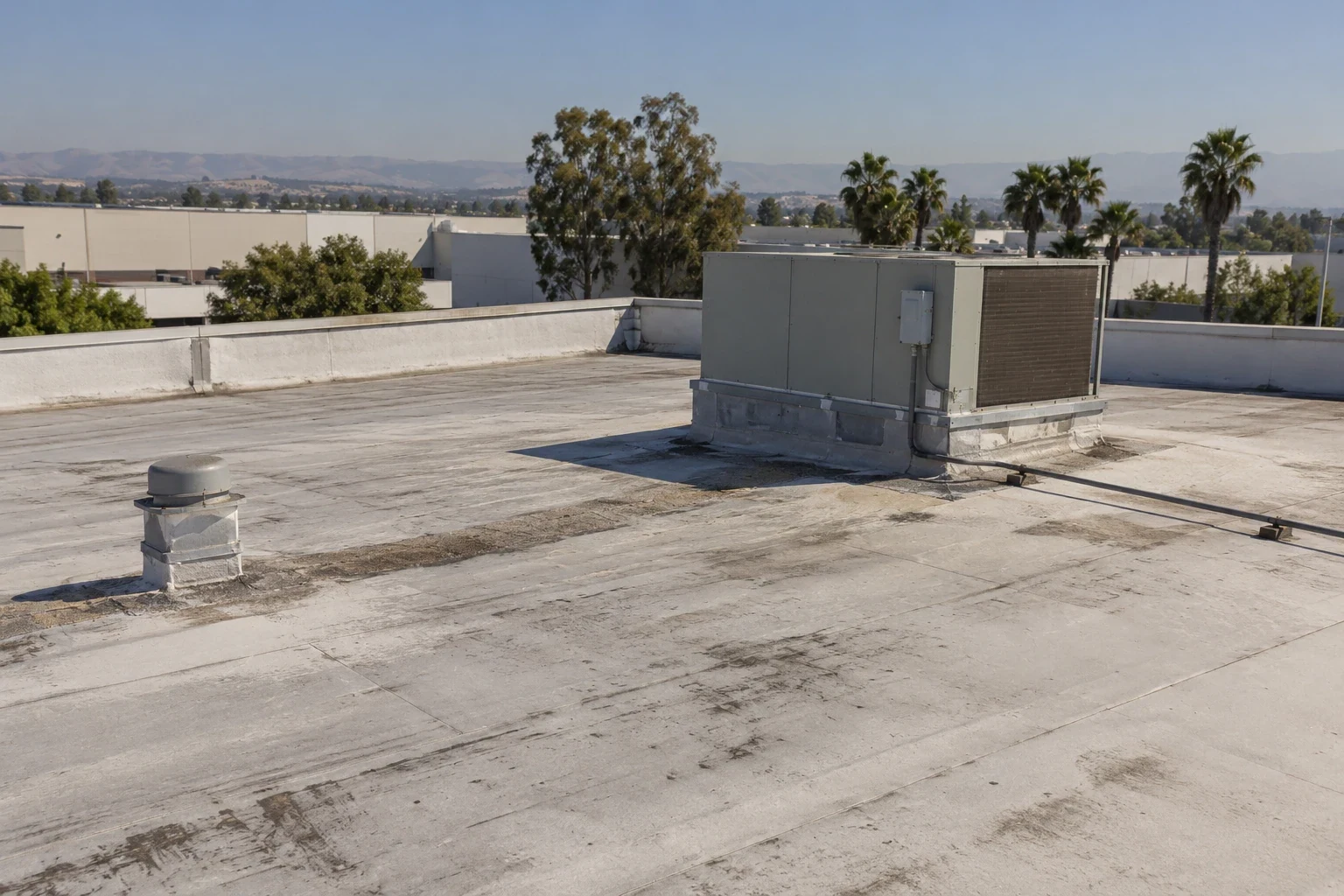
Plan warehouse roof repairs and replacement in Vacaville around heat movement, drainage, loading access, and the building’s operating schedule.
The National Weather Service recorded Vacaville’s 115°F high on September 5 and 6, 2022; warehouse seams and edges still need a physical movement check. That weather context makes movement at warehouse roof seams and edges worth inspecting. It does not establish damage at a particular building. We check the membrane, attachment, perimeter metal, equipment curbs, and drainage paths, then compare those observations with the owner’s leak history and operating window. Warehouses near the I-505 corridor between Vaca Valley Parkway and Midway Road may have different delivery and access constraints from a property near downtown. The roof survey turns those site conditions into a repair boundary, a replacement choice, and a workable close-in sequence.
Start with the layers
A warehouse roof can include membrane, insulation, cover board, vapor control, and a deck, but its actual assembly has to be confirmed. We review available roof records and look at visible seams, fasteners, prior patches, and exposed edges. If a leak or soft area suggests concealed moisture, a targeted test can show whether the concern is local or spread across a larger zone. We mark the limits on a roof plan and record which layers were observed, tested, or remain unknown. That distinction keeps a repair estimate from treating one wet area as proof that the entire field needs removal.
For a newer building or a recover option, attachment and load transfer matter as much as the membrane name. We check substrate condition, fastening pattern, perimeter zones, and transitions around walls and equipment. An owner comparing options can review roof planning for a distribution center when the same property has high-throughput areas, or manufacturing roof considerations when process equipment changes access. The recommendation still follows this building’s assembly and documented condition.
Trace movement at the seams
Repeated sun exposure warms a roof surface and can move sheets, metal, and fasteners through the day. We inspect lap edges, end laps, curb flashing, and termination points for separation, wrinkles, pulled fasteners, or a bond line that has stopped holding. A patch has to reach sound receiving material and remain compatible with the existing sheet. Coating over a split does not reconnect a separated seam. The repair notes identify the transition that failed, the preparation needed, and any test that could change the scope before a larger area is covered.
Vacaville’s biotechnology, pharmaceutical manufacturing, advanced manufacturing, and logistics activity includes buildings with distinct production and storage needs. Those sectors do not prove a particular roof type; they do make equipment access and shutdown coordination practical questions. We record which aisles or systems must remain available and place noisy or disruptive work in an agreed window. When membrane selection is part of a new assembly, compare TPO roof options with the deck, insulation, attachment, and perimeter details rather than choosing by name alone.
Keep water moving away
Warehouse roofs often have broad drainage fields interrupted by curbs, vents, and roof-mounted equipment. We trace runoff toward each drain or scupper and note low areas, blocked paths, loose strainers, and places where a patch has changed the surface. Ponding can keep a seam or repair wet longer than intended, so the roof plan should show both the outlet and the area feeding it. If a drain connection or overflow is part of the problem, drain and scupper repair can be scoped with the membrane work.
Drying time matters after a leak as well as during installation. A moisture survey can help map a suspected wet area, while a test opening confirms the layers at selected points. We do not infer hidden insulation condition from a ceiling stain or from the shape of a roof. The report marks where the evidence changes, what remains uncertain, and whether water can leave the assembly as designed. This is especially useful when a property owner needs to compare a localized repair with removal of wet material in several separated zones.
Protect receiving and loading areas
A warehouse can keep receiving goods while roof work proceeds, but only if access, lifting, and weather protection are planned around its actual operation. Before an opening is made, we identify delivery lanes, dock doors, pedestrian routes, roof access points, and any interior area that needs protection. Material staging and crane placement depend on the site layout and owner approvals. We divide the roof into sections that can be prepared, repaired, and closed within the agreed window. A written occupied-building work sequence records those boundaries so the roof stays protected as work moves across it.
The I-505 industrial corridor west of North Village and Vaca Valley Business Park are separate Vacaville areas with their own access context. For either location, the building’s gate rules, delivery route, and loading schedule come from the property team. We confirm those details before setting crew arrival and material movement. If a recover is being considered, an overlay review checks existing layers and added weight before the owner commits to a sequence. The proposal identifies hold points where a concealed condition or schedule change needs review.
Compare repair with renewal
A repair can make sense when the failed area is defined, adjacent membrane remains bonded, and the receiving surface can accept a compatible detail. Several leaks, recurring seam movement, wet insulation across multiple zones, or a deteriorated deck can make selective removal or full replacement more appropriate. We show the evidence for each path instead of sizing a project from the most visible symptom. Cost and timing change with roof access, tear-off depth, disposal, equipment coordination, insulation requirements, and weather protection. A commercial roof inspection gives the owner a condition record to compare with the proposed scope.
Vacaville adopted the 2025 California Building Standards Code by ordinance in November 2025. The governing permit and project team determine which provisions apply to a warehouse alteration. We coordinate the roof assembly with curb heights, equipment supports, insulation, and any envelope work in the approved plans. A roof-condition record should include photos, test locations, repaired zones, materials, and open items for the next inspection. Owners managing several properties can use a roof condition report to carry consistent observations into capital planning without treating separate buildings as one condition.
Questions Owners Ask
A warehouse has several small leaks. How do you tell whether they share one cause?
We map each interior symptom to the roof zone above it, then inspect nearby seams, drains, curbs, and previous repairs. Separate stains can share a drainage or assembly issue, but the roof survey must show a connection before we combine the work. Moisture testing or a targeted opening can distinguish a local detail from a wider affected area.
Can roof work continue while loading doors remain active?
Yes, when the site plan keeps deliveries, pedestrians, equipment, and weather protection clear of the active work area. We coordinate staging and lifting with the property team, then divide the roof into sections that can be closed within the approved window. The schedule changes if the building cannot protect a receiving route or interior operation.
What makes a warehouse roof suitable for a recover?
The existing layers must be stable, sufficiently dry, attached, and compatible with the proposed assembly. We check roof records, test uncertain areas, review deck and perimeter conditions, and account for added weight and curb height. If wet insulation or weak attachment extends beyond a defined repair, removal may be the better comparison.
Does a heat advisory mean a warehouse roof needs replacement?
No. A regional forecast is context for inspection, not a reading of the roof surface. We look for actual separation, fastener movement, moisture, and loss of bond, then document what we find. The record alone does not establish roof damage or the remaining service life of a particular assembly.
What should a warehouse owner receive after the repair?
The closeout should identify the repaired roof zone, materials, transition details, photos, and any condition left for future review. We note where the inspection could not confirm concealed layers and what test would resolve that question. A clear record helps the next maintenance visit compare new symptoms with the work already completed.
Related Roofing Work
- Distribution Center Roofing in Vacaville, CA
- Manufacturing Plant Roofing in Vacaville, CA
- TPO Roofing in Vacaville, CA
- Commercial Roof Drain and Scupper Repair in Vacaville, CA
- Occupied Commercial Building Reroofing in Vacaville, CA
- Commercial Roof Recover and Overlay in Vacaville, CA
- Commercial Roof Inspection in Vacaville, CA
- Commercial Roof Condition Reports in Vacaville, CA
Share the leak locations, roof records, loading schedule, and access limits. We will inspect the assembly, map drainage and seam conditions, and document the repair or replacement boundary with timing considerations.