Auto Dealership Roofing in Vacaville, CA
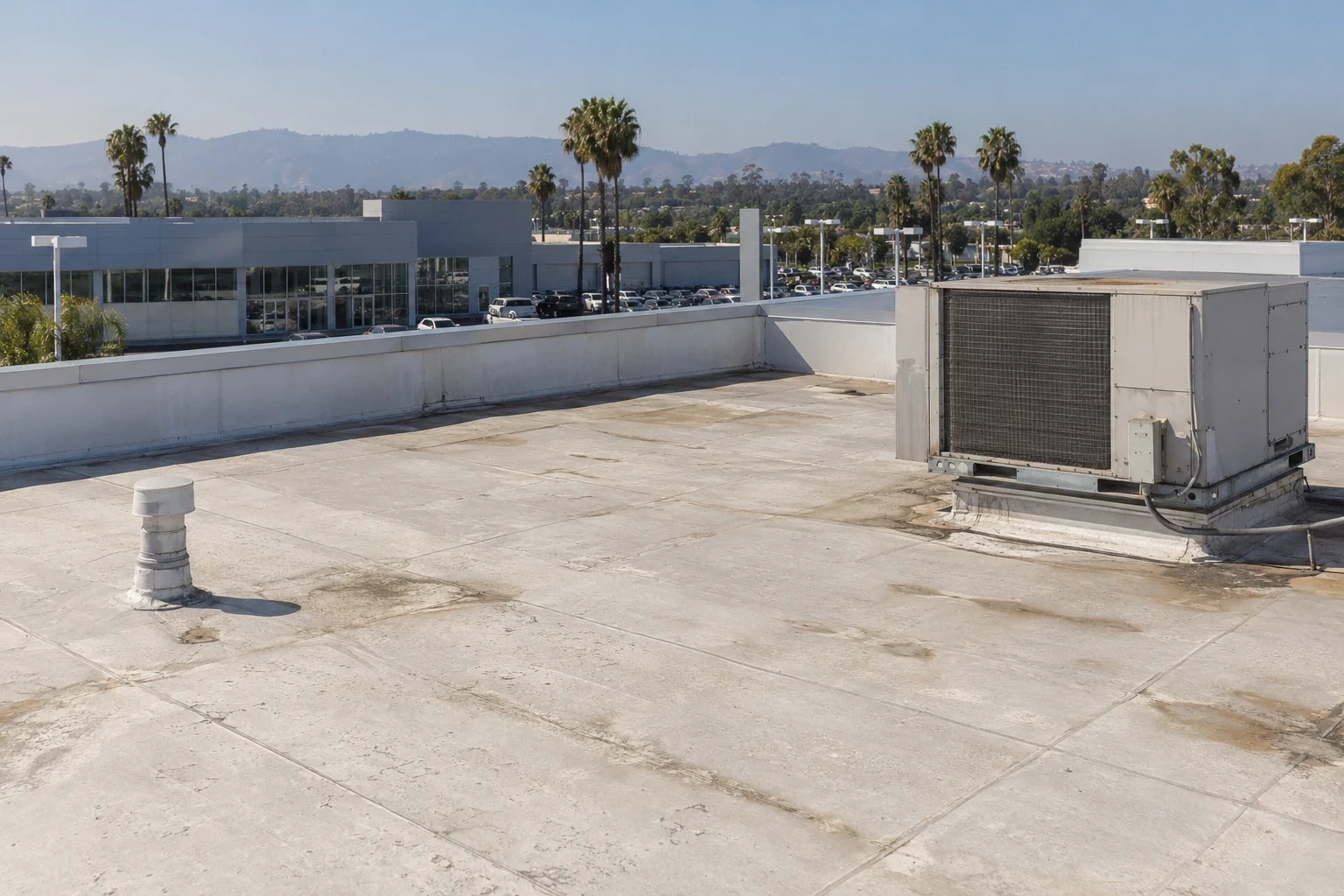
Plan Vacaville dealership roof repairs around showroom traffic, service bays, vehicle staging, drains, customer access, and safe close-in times.
A dealership roof protects more than showroom inventory. Service bays, parts storage, customer entrances, and office space can sit under different roof zones, with daily operations depending on clear doors and reliable close-in. The first visit maps those areas with the property contact and identifies where equipment, vehicle movement, or interior protection affects access. We then trace leaks and inspect the actual membrane, metal, drainage, and penetrations. A regional weather advisory that included Vacaville may inform when exposed work is planned, but it cannot tell us whether a dealership roof needs repair or renewal; that decision comes from field findings.
Coordinate showroom and service-bay traffic
Start the dealership walk with the operating manager. Identify which service doors remain in use, whether vehicles move beneath the work area, and where customer access must stay clear. The roof map can then divide showroom, shop, parts, and office zones without treating the building as one open work surface. A occupied-property work plan sets daily limits; the nearby Downtown Vacaville and North Village references can help organize scheduling, not determine site rules. The property representative approves those rules.
Separate showroom, service, and storage roofs
Showrooms and repair bays can have different roof geometry and equipment loads. Note skylights, exhaust fans, curbs, rooftop units, and any point where a service-bay addition meets older construction. A leak over a parts area may follow a different path from water entering near a customer entrance, so mark each report on the plan and inspect the closest transitions before opening the assembly. If a separate storage or distribution building is on the parcel, keep its roof history distinct. A warehouse roof assessment can address that building without blending its findings into the dealership record.
Inspect ventilation, lifts, and rooftop units
Service departments may use exhaust, compressed-air piping, electrical conduit, and rooftop mechanical equipment. We inspect curbs, supports, penetrations, fasteners, and flashing around the equipment that is actually present. If a unit or line must be moved, the dealership identifies the mechanical contractor and confirms how the service bay will operate during that period. Roofing scope describes the membrane work separately from equipment disconnection or repair. A curb and support inspection can record each transition and the clearance required for later servicing.
Vacaville’s economy includes advanced manufacturing, industrial production, biotechnology, and logistics. Those sectors describe broader activity rather than the equipment inside one automotive property. We inspect the actual roof and document whether a curb edge, fan base, or conduit boot needs correction. Water that collects near a support can involve slope or drainage, not just flashing. A drain and scupper review checks the outlet serving that area and helps keep the repair boundary tied to the whole water path.
Rooftop exhaust and make-up air deserve attention where service bays produce heat or fumes. Confirm that units can be reached without crossing fragile skylights or unprotected roof edges, and note whether a curb has been altered during equipment replacement. A leak near a bay may follow a duct curb, conduit, or wall transition, so mark the interior report and compare it with the nearest roof penetration before proposing a patch. If the problem is confined to one zone, keep the showroom and parts areas outside the scope unless inspection shows a connection. Photograph the curb and adjacent membrane from a safe position, and record any service contractor whose work could have changed the flashing. The dealership manager should know which door, lift lane, or vehicle route may be affected before a crew mobilizes. A proposed repair can then show both the roof detail and the short operating interruption needed to complete it.
Follow water without interrupting vehicle work
A ceiling mark above a service writer’s desk may be away from the roof opening, while water near a repair bay can also relate to a plumbing or equipment line. We compare the report with seams, drains, wall transitions, prior patches, and recent service work. Moisture testing can clarify the assembly at a selected point. The Diligence Notes records the method and layer observed instead of extending one reading across the whole property. When an opening is needed over a customer area, the operator sets protection and an access limit before the test is made.
Periods of high afternoon heat can increase movement at laps and metal joints. We inspect the actual lap bond, perimeter metal, and substrate before changing the scope. We check lap bond, perimeter metal, and the receiving surface for a compatible repair. A commercial roof inspection can organize photos by showroom, service, or storage zone. Any water path that remains uncertain is listed as a test question rather than treated as confirmed damage.
Price the work by roof zone and operating constraint. Separate mobilization, protection of vehicles or interior finishes, removal, disposal, membrane or panel work, and any curb or drain corrections. A dealership may ask to keep customer parking available while a rear service wing is repaired; note the staging location and route before the crew arrives. The proposal should state how an unexpected wet area changes the boundary and who can approve an added opening. A clear allowance avoids promising a fixed repair area before the substrate is exposed. Schedule noisy work around the owner’s confirmed activity window.
Compare repair options against dealership hours
A local repair can suit a defined opening when adjacent material remains stable and testing does not indicate a larger wet area. Repeated leaks, loose attachment across several sections, or deck deterioration can justify selective removal or a replacement study. We compare the alternatives against delivery schedules, vehicle staging, noise, material handling, interior protection, and the time needed to close each section. An overlay belongs on the table only after layer count, attachment, moisture, and deck condition are checked. If those findings do not support another assembly, the owner can compare selective removal with full replacement.
The work order names the roof zone, access contact, trades, and observations that could change the scope. At closeout, photographs identify each repaired transition and any area that remains on a monitoring list. A property with a customer-facing retail wing can also compare shopping-center roof planning for shared pedestrian paths. The dealership receives a plan specific to its service appointments, showroom hours, and vehicle routes, along with the next inspection point.
For a phased project, sequence roof zones around the dealership calendar and confirm the affected department before each mobilization. A showroom closure, service-bay restriction, and parts-delivery interruption have different effects on the business. The work plan should identify where materials will be lifted, where debris will leave the building, and how the public route remains separated from the crew. If the roof inspection finds wet insulation beyond the visible leak, show the change as a defined alternate rather than silently enlarging the base scope. Ownership can then choose between a limited correction and a broader renewal with a clear record of the evidence that changed the decision.
Questions Owners Ask
Can dealership operations continue during roof work?
Management identifies customer routes, delivery windows, and service-bay access. We phase work around those limits and confirm a close-in time before a lane reopens.
What should be checked above an auto service area?
We inspect the roof field, exhaust and equipment curbs, penetrations, drainage, and previous repairs above the reported location. Another trade may need to confirm a line or unit.
Does a ceiling stain show where water entered?
Not by itself. Water can move across the assembly before it appears inside. The inspection compares the symptom with the seams, walls, and outlets above the space.
How can a vehicle lot affect roofing logistics?
The operator sets a lift location and material route that keep required vehicle and customer paths open. The schedule can change if deliveries or appointments shift.
When is a larger scope worth evaluating?
Moisture in several roof zones, recurring leak reports, or loose attachment can support a selective-removal comparison. Testing identifies what portion needs that review.
Related Roofing Work
- Occupied Commercial Building Reroofing in Vacaville, CA
- Commercial Roofing in Downtown Vacaville, CA
- Commercial Roofing in North Village, Vacaville, CA
- Warehouse Roofing in Vacaville, CA
- Commercial Rooftop Equipment Curbs and Supports in Vacaville, CA
- Commercial Roof Drain and Scupper Repair in Vacaville, CA
- Commercial Roof Inspection in Vacaville, CA
- Shopping Center Roofing in Vacaville, CA
Share the leak report, roof history, operating hours, and vehicle-access rules. We can document the affected roof area and sequence work around customer and service traffic.