Commercial Roof Flashing Repair in Vacaville, CA
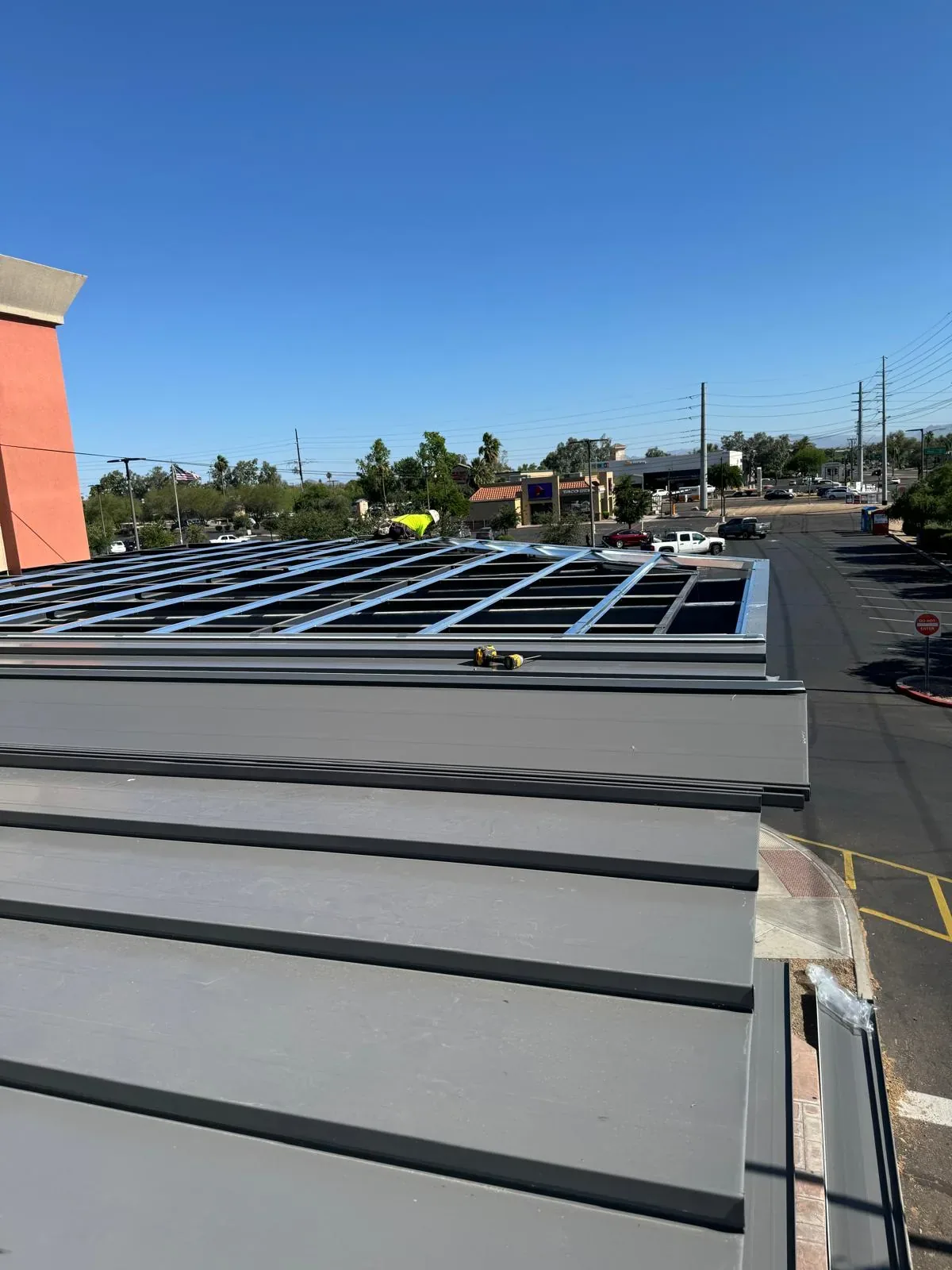
Repair failed commercial roof flashing in Vacaville, CA. We inspect curbs, walls, drains, and edges, then set a boundary on sound receiving material.
Very hot days and warm nights in a Central Solano County heat advisory included Vacaville, a measured reason to inspect movement at roof transitions without treating weather as proof of failure. Flashing connects the field membrane to a wall, curb, drain, or edge. If its bond line opens, water can reach the assembly even while the broad sheet looks intact. We check the adjoining surfaces, fasteners, and drainage path, then identify where a repair can tie into firm material. Downtown Vacaville supports more than 450 businesses across several industries, while Vaca Valley Business Park has a distinct industrial and biomanufacturing context. Neither tells us what is installed on a specific roof. The inspection records the actual transition before we choose a repair.
Find the failed connection
At a parapet, flashing may turn from the roof field up a wall and terminate beneath coping or a counterflashing strip. At a curb, it must close around corners and meet equipment without leaving a gap at the base. At a drain, the membrane connects to a clamping assembly and outlet. We inspect which joint has released, whether the substrate is sound, and whether movement extends past the visible opening. A penetration flashing repair can address a detail around a skylight or pipe, while a broad seam or field split needs a different scope. We name the transition, not just the stain below it.
At a curb corner, the vertical flashing and the horizontal roof sheet meet under different movement and water exposure. We check both legs, the corner folds, and the point where the top edge is secured. At a parapet, the counterflashing must protect the upper termination without trapping water behind the membrane. If an older layer remains beneath the visible sheet, we note whether the new work can tie into it or must be removed to reach a stable base. These details change labor and preparation more than a broad roof-area estimate suggests.
Prepare material that can hold a new bond
A patch must land on a compatible receiving surface that is clean, dry, and attached. Loose coating, oxidized metal, wet insulation, or a moving sheet can defeat a new seal even when the repair looks complete from above. We lift enough material to inspect the interface, remove failed components to a stable edge, and record any concealed condition that changes the quantity. On a thermoplastic roof, welding preparation differs from an adhered EPDM detail, so the system found controls the repair method. We can compare that condition with EPDM membrane work when the field assembly calls for taped seams and compatible flashing materials.
Trace water beyond the transition
Water can travel along a deck or insulation before appearing on an interior ceiling. We compare the reported room with the curb, wall, outlet, and adjacent seam above it, then inspect the path runoff follows. If ponding remains at the same transition, the repair must account for that wetting pattern rather than simply cover the visible crack. A drainage inspection can document an outlet that holds water beside failed flashing. When wind has moved metal or sheet material, a wind damage review can add a separate check of the perimeter attachment. Each condition gets its own location and repair limit.
When an interior report follows a roof penetration, we compare the room location with the curb or pipe above and look for water tracks on the deck. The entry point may not align vertically with the mark indoors. We map the path and note whether another trade recently changed a support, conduit, or equipment base. If the substrate is damp, drying and replacement limits are set before the flashing closes over it. This keeps a renewed seal from hiding a wet assembly that needs separate attention.
Plan work around the building use
Downtown Vacaville's business district includes a range of commercial activity, and Vaca Valley Business Park is associated with local biomanufacturing development. Those settings can involve customer access, equipment routes, or process schedules, but we confirm the actual building's rules before staging a lift or opening the roof. The Downtown Vacaville service area includes different roof forms and property operations; a field survey identifies the one being repaired. At a site with production equipment, we record which intake or support sits beside the curb and who can approve a shutdown. That preparation limits open time and keeps access decisions tied to the work zone.
Price the detail and its adjoining work
Estimate drivers include curb or wall length, metal condition, sheet compatibility, access equipment, removal depth, and whether moisture extends beneath the transition. We list replacement flashing, fasteners, sealant, membrane tie-in, and interior protection as separate elements where needed. If the receiving surface is stable, the repair may remain local. If multiple curbs show release or the metal has failed across a long parapet, broader work can be compared using the same roof map. A seam failure repair is appropriate when the lap itself has separated, and a commercial roof repair can combine related details under a defined scope. We document any testing that could change the boundary before final quantities are set.
Keep the detail legible for later service
Closeout photographs show the full transition and its finished tie-in, not only a close crop of new sealant. We record the material installed, the preparation completed, nearby drainage, and any adjacent section left outside the work. This helps a later inspector distinguish a repaired joint from a new opening or an unrelated stain. A condition report can carry the marked roof zone and photographs into the property's maintenance file. We also note any inspection access that was not available, so future work does not rely on an assumption that the whole roof was observed. The owner receives a clear repair boundary and a practical next check. We can also identify the date for a follow-up view when the repaired junction has been exposed to ordinary roof use. The next observer compares the same lap, curb, or edge and records whether the seal remains bonded. If the detail is adjacent to equipment planned for replacement, the owner can share the dimensions and approved access window before that trade mobilizes. A short record at the handoff can prevent later work from cutting through a newly restored transition.
Questions Owners Ask
Can flashing be repaired without changing the roof membrane?
A local detail can be repaired when the sheet remains attached and the new flashing can bond to sound material. We inspect the seam, substrate, and moisture boundary first, then show what must be removed to reach a stable tie-in.
Why does a curb leak after equipment work?
A moved unit can change curb height, expose old fastening points, or leave flashing unsupported. We inspect the base and nearby membrane, then coordinate the repair sequence with the mechanical contact before closing the detail.
Should sealant be added over a cracked flashing joint?
A surface bead may not hold if the metal or membrane continues to move. We identify why the joint opened, prepare compatible material, and include sealant only as part of a detail that has a sound attachment and termination.
What if insulation is wet below the flashing?
We mark the affected area and remove material until the deck and remaining insulation provide a stable boundary. The scope separates that removal from the new flashing, membrane tie-in, and protection needed below.
Which photos help document a flashing repair?
Keep an overview of the roof zone, close views of the failed joint, a photo of exposed layers if opened, and the completed tie-in. We label each image by location and date so it can be compared on a later visit.
Related Roofing Work
- Commercial Roof Inspection in Vacaville, CA
- Commercial Skylight and Penetration Flashing in Vacaville, CA
- EPDM Roofing in Vacaville, CA
- Commercial Roof Drain and Scupper Repair in Vacaville, CA
- Wind Damage Roof Repair in Vacaville, CA
- Commercial Roofing in Downtown Vacaville, CA
- Commercial Roof Seam Failure Repair in Vacaville, CA
- Commercial Roof Repair in Vacaville, CA
Share the interior report, roof plan, and access window. We will inspect the curb, wall, drain, or edge connection, document the receiving surface, and define the repair limit.