
Commercial Roof Insulation and Cover Board in Vacaville, CA
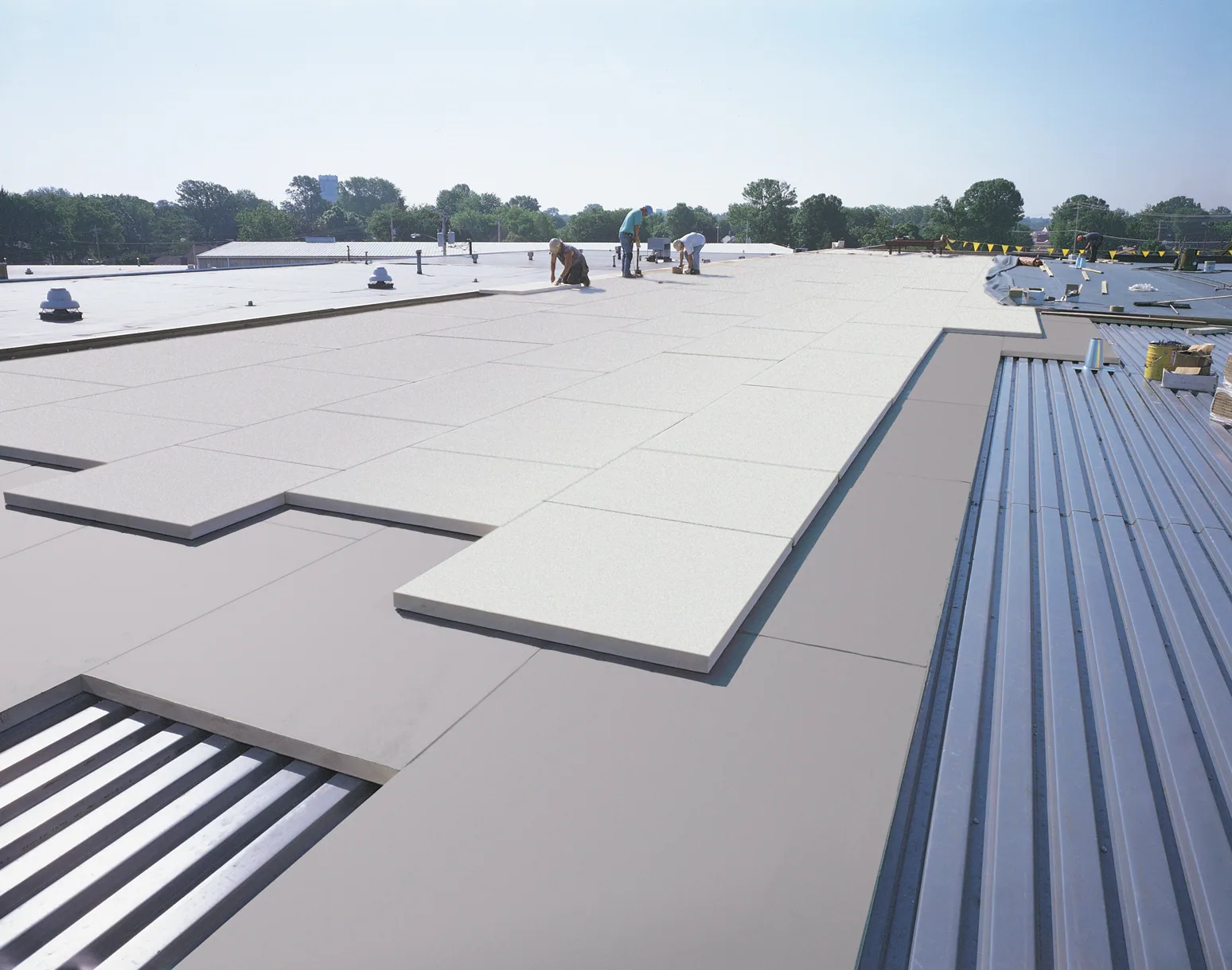
Assess Vacaville commercial roof insulation, cover board, moisture, attachment, and transitions before defining repair or replacement limits.
Insulation and cover board sit between the roof membrane and the deck, so a wet, crushed, or poorly attached layer can affect more than the surface finish. Heat movement can affect the bond between insulation boards, cover layers, and membrane; we trace those interfaces before selecting a replacement assembly. We inspect the visible roof, review available records, and mark where a test opening could clarify the layers. A commercial roof inspection separates observed membrane conditions from questions about concealed insulation.
Identify the assembly before proposing a cover board
A roof may contain one or more insulation boards, tapered sections, a cover board, attachment plates, and a membrane installed at different times. We review drawings, prior repair records, and visible edge conditions to understand what may be beneath the surface. If records conflict with field evidence, the report calls out the mismatch rather than assigning a layer based on appearance alone. A test cut can confirm thickness, facer, moisture condition, and attachment, but it needs an agreed location and patch procedure. We also inspect the perimeter and rooftop penetrations because those transitions can expose board edges or reveal how many layers were added over time. At a drain or scupper, a height change may affect the path to the outlet; at a curb, it can change the flashing height and available attachment. The survey notes these interfaces so the design team can evaluate more than the flat field. Where a building has several roof sections, each assembly is mapped separately rather than assumed to match a neighboring wing. Industrial land follows I-505 between Vaca Valley Parkway and Midway Road, west of North Village, where each roof still requires a layer survey. The scope should state what was exposed and what remains inferred. A TPO roof system review or EPDM assembly review can help frame membrane-specific tie-in requirements.
Map wet or compressed insulation by area
Softness, deflection, ponding, or staining can suggest a change below the membrane, yet none is enough on its own to define how far moisture extends. We mark visible symptoms on a roof plan and compare them with drains, seams, penetrations, and reported interior locations. Infrared or capacitance readings can help prioritize openings when suitable for the roof and weather conditions, but readings require ground-truth confirmation. A test opening should be placed where its result will change the repair scope, not simply where access is easiest. The report distinguishes confirmed wet material from suspected areas and notes the date and conditions of each observation. If the membrane has a breach, a localized repair can address that entry point while the insulation extent is evaluated separately. A drainage check may also be needed where water remains at a low point.
Match cover board performance to the roof use
Cover board can provide a more stable surface for membrane attachment, spread some service loads, and protect underlying insulation, depending on the specified product and assembly. Selection should account for the membrane, attachment method, wind design, expected foot traffic, rooftop equipment, and manufacturer requirements. A harder board is not automatically suitable if the deck or insulation below cannot support the fastening pattern. We look at board joints, plate pull-through, crushing around service paths, and transitions at curbs or perimeters. Advanced manufacturing, industrial production, and logistics are Vacaville target sectors; equipment loads still come from the mechanical schedule for the specific roof. An engineer or system manufacturer may need to confirm design criteria. A replacement scope can compare board options with the selected membrane and existing deck condition.
Keep fastening and transitions consistent
Board attachment must suit the deck, board type, membrane system, and design pressures in the project documents. We note loose plates, gaps, irregular joints, and places where repeated patching has changed the surface. At perimeters and penetrations, the transition must account for board thickness so the membrane does not bridge an unsupported step or leave an abrupt edge. A tapered layout can direct water toward a drain, but the slope, drain elevation, and available build-up have to be checked together. When a reroof adds layers, height changes at doors, curbs, and edge metal also need review. Vacaville planning proposals in 2025 included industrial and commercial construction, but existing roof assemblies are established by drawings and field openings. We use field dimensions and approved details for each project. A coating review is appropriate only when the existing substrate and system qualify for that treatment.
Define the test opening and repair boundary
Before cutting a roof, the team agrees on the test location, opening size, protection of the occupied space below, and the materials needed to restore a watertight surface that day. The opening should expose enough of the assembly to answer the question while avoiding utilities and sensitive equipment. We photograph each layer as it is removed, record measured thickness, note moisture or compression, and capture the deck condition. If wet insulation is found, the boundary is extended only where evidence supports it, with additional openings if needed. The daily close-in plan identifies who verifies membrane tie-in and checks the interior area after work. If the opening exposes a saturated facer or degraded deck, we pause at the agreed boundary and photograph the condition before extending removal. That evidence lets the owner authorize the next step with a clear change in scope rather than an undocumented expansion. A leak investigation can trace a reported interior path, while the insulation survey documents the assembly separately. The record should not convert a limited sample into a claim about every roof section.
When test cuts differ across the roof, we mark each result by zone and do not extrapolate a single opening to the entire assembly. That map helps the owner decide whether another sample changes the removal limit.
Carry confirmed layer data into capital planning
Once the board, insulation, deck, and membrane conditions are understood, the owner can compare localized replacement, a recover where permitted, or full tear-off. The alternatives should name the area, layer removal, new attachment, transition work, and disposal assumptions so the price comparison is meaningful. We note how roof height changes could affect drains, curbs, edge metal, and access. A phased plan can keep the work boundary clear when only a portion of the building is ready for replacement. The City land-use map identifies the Vaca Valley Business Park district as an existing policy-plan area. Downtown Vacaville is a separate setting; neither map replaces a roof plan and assembly survey. A roof capital plan can organize confirmed conditions by priority, and the broader service corridor does not replace site measurements. Closeout records preserve test locations and the assembly installed.
Questions Owners Ask
Can insulation moisture be confirmed without opening the roof?
Non-destructive readings can help identify areas for follow-up, but a test opening is often needed to verify the layer condition. The report separates readings from confirmed wet material.
Does a new cover board fix ponding?
Not by itself. Drain elevations, slope, deck condition, and membrane details all matter. A proposed tapered layout should be measured against the actual outlets and assembly height.
When should wet insulation be removed?
Removal limits follow confirmed moisture, board condition, and the assembly design. We map test results and identify where additional openings are needed before defining removal limits.
Can an existing roof be recovered over insulation?
That depends on moisture, attachment, deck condition, code, warranty, and system compatibility. A field survey and manufacturer or design review establish whether a recover is suitable.
What should a test cut record include?
It should identify the roof location, layer sequence, measured thickness, moisture and deck observations, photographs, and the repair method used to close the opening.
Related Roofing Work
- Commercial Roof Inspection in Vacaville, CA
- TPO Roofing in Vacaville, CA
- EPDM Roofing in Vacaville, CA
- Commercial Roof Repair in Vacaville, CA
- Commercial Roof Drain and Scupper Repair in Vacaville, CA
- Commercial Roof Replacement in Vacaville, CA
- Commercial Roof Leak Repair in Vacaville, CA
- Commercial Roof Capital Planning in Vacaville, CA
Share the roof area, prior repair records, and any interior moisture reports. We will document visible conditions, identify where a test opening could answer the assembly question, and define the close-in and follow-up steps.